15-Second Splicing: How SMT Reel Change Cycle Time Is Actually Cut
Nov 23, 2026Ten years ago, evaluating a pick-and-place machine meant looking at CPH; today, evaluating a line means looking at OEE. The metric has changed, and so has what gets counted. Auxiliary actions—reel changes, splicing, tail-end cleanup—used to be excluded from capacity calculations; now they're all in the denominator.
As a result, the nature of splicing has changed too: it's no longer "two people coordinating for a moment," but a segment of labor time that must be scheduled into the cycle.
I. First, Let's Clarify Three Numbers
When discussing whether splicing is fast, the most common mistake is mixing up three different time measurements.
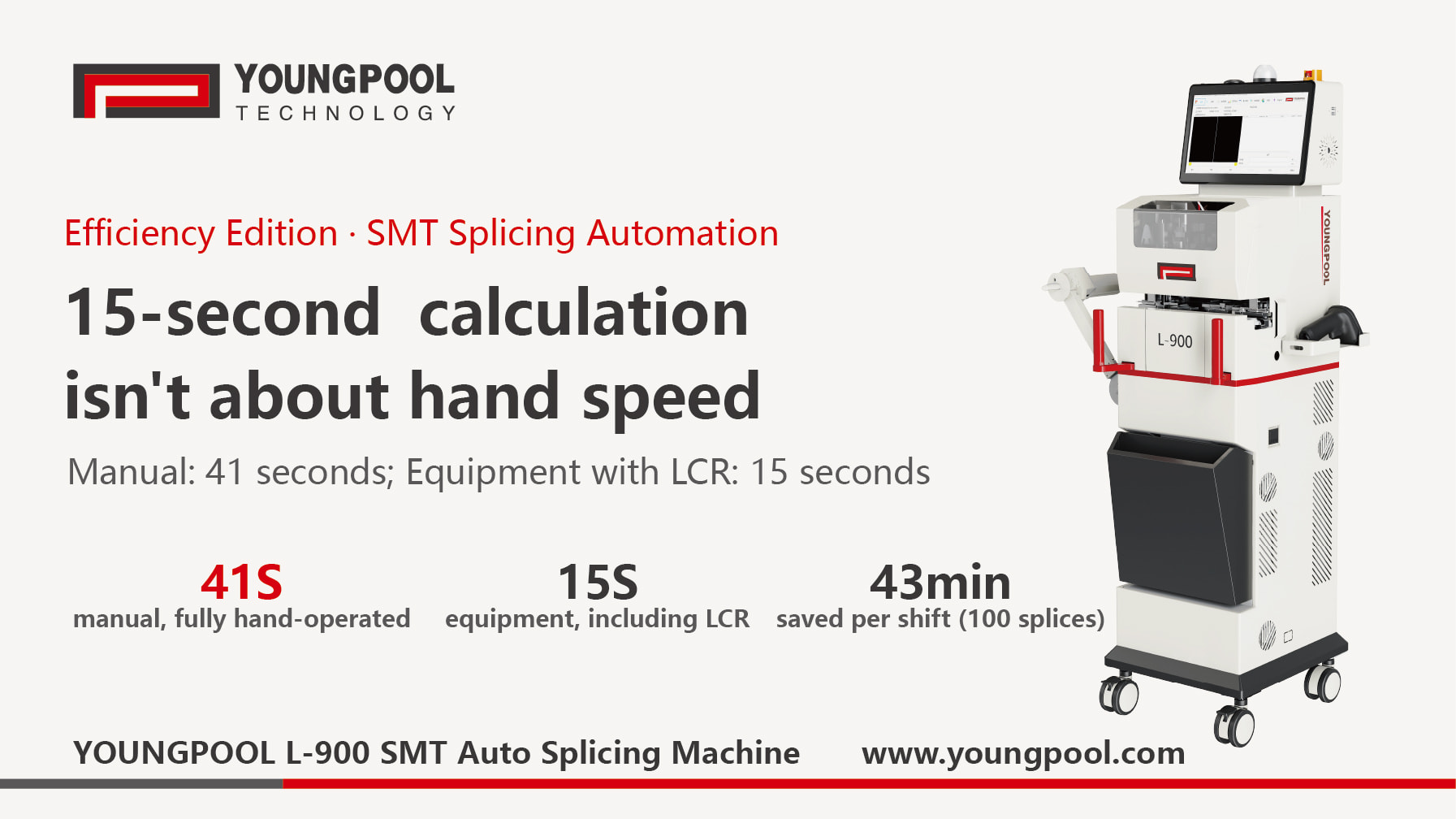
The first is pure motion time: the segment where hands are on the carrier tape. On-site timing shows manual splicing (excluding LCR) averages 41 seconds.
The second is time including measurement: after splicing, you still need to grab a multimeter, flip the reel, and record the value—about 120 seconds manually.
The third is complete reel change time: from the pick-and-place machine alarm, walking to the workstation, retrieving material, splicing, to reset—3–8 minutes per occurrence.
These three numbers don't conflict; they're three different scopes. The 15 seconds the splicing machine advertises refers to the first and second scopes—the L900's full process including LCR measurement is 15 seconds, and 9 seconds without measurement. It doesn't benchmark against the 3–8 minutes, because those 3–8 minutes include walking and material retrieval—the machine doesn't walk for you.
Note | Scope Reminder: 41 seconds and 120 seconds are on-site timing values, varying with carrier tape specifications, component sizes, and operator proficiency; 9 seconds / 15 seconds are L900-01 catalog nominal values. Do not mix the two types of numbers.
II. Breaking Down 41 Seconds: Less Than 10 Seconds Is Actual Film Application
Breaking down a manual splice into motions, it looks roughly like this:
· Finding the splice point, identifying direction (2–4 seconds)
· Aligning positioning holes, aligning tape pockets (8–12 seconds)
· Peeling release paper, lifting film (3–5 seconds)
· Pressing, smoothing (4–6 seconds)
· Visual inspection of the seam, rework if necessary (5–10 seconds)
· Recording, labeling (3–5 seconds)
The actual "applying" motion is less than 10 seconds. The remaining thirty-plus seconds are spent establishing references, confirming, and recording.
This isn't slow hands. It's that the motions are broken into serial steps: each step must wait for the result of the previous one, and each time you must re-find a position that "looks right."
III. Adding LCR: Why Time Triples
Manual electrical verification follows a different chain: find the multimeter, power on, select range, touch the probes, read the value, compare with nominal, write it down.
It's not slow at "measuring"—it's slow at "switching tools." The hand moves from the carrier tape to the probes and back to the tape; those few seconds in between produce nothing, and you have to re-establish the feel.
So manual time including measurement is 120 seconds—not 41 plus 20, but nearly triple. Many factories don't factor this multiplier into their production scheduling.
IV. What the Machine Changes Isn't Speed—It's the Serial Relationship
What the L-900 does, in essence, is convert three serial segments into one parallel segment: vision identifies positioning holes and tape pocket contours,deviation is compensated in real time before pressing, and LCR measurement is completed within the same travel.
Splicing: 9 seconds; full process including LCR: 15 seconds; film application precision ±0.1mm, splice point gap ±0.1mm, splicing pass-through rate 98%.
Note that what's eliminated here isn't "hand speed"—it's three things:
· Time spent finding references—vision replaces visual inspection;
· Time spent switching tools—measurement no longer requires a separate set of tools;
· Time spent judging and recording—out-of-window conditions are directly flagged as anomalies, and splicing records can feed into MES.
V. Constants Matter More Than Averages
This is the most easily underestimated point about splicing machines.
Manual splicing CT is a distribution: a skilled worker at 35 seconds, a novice possibly at 90 seconds, night shift slower than day shift. The average is 41 seconds, but the variance is large.
Machine splicing CT is a constant.
For production schedulers, a constant and an average are two different things: an average can only be used for monthly accounting; a constant is what enables cycle scheduling, workstation balancing, and changeover window calculation.
Let's do the math (illustrative, not standard values): a high-frequency reel change line, 100 splices per shift.
· Manual pure motion: 100 × 41 seconds ≈ 68 minutes
· Machine: 100 × 15 seconds = 25 minutes
· Difference per shift: 43 minutes; if LCR is included, manual is about 200 minutes—a difference of nearly 3 hours.
Note | Scope Reminder: 100 splices per shift is an illustrative assumption; please convert based on your factory's reel change frequency. For multi-line totals of 300 splices, the difference scales proportionally.
VI. High-Mix, Low-Volume: The Biggest Beneficiary
The changeover window is the most hidden item in this calculation.
High-mix, low-volume means frequent line changes, and within the changeover window, splicing is the step most likely to drag on time—because it requires people, judgment, and waiting. Only when splicing time shifts from "depending on people" to "depending on the clock" can the changeover window be scheduled tightly.
Conversely, for a single-product, high-volume line that changes material only two or three times a day, manual splicing is entirely sufficient—the machine's value isn't in speed.
VII. Written for Two Types of People
For managers: Don't evaluate a splicing machine by "how many people it can save." First ask, "Is the splicing CT a constant?" Because only constants can enter production scheduling.
For operators: Your hands haven't slowed down—it's that this set of motions is broken up too finely: find, align, peel, press, check, record—each step must start over. Handing repetitive judgment to the machine isn't because hands aren't capable; it's because this process was never meant to be guaranteed for consistency by hand.
15 seconds isn't a show of skill. It changes "people waiting for machines" into "machines waiting for people." Next article: Within those 15 seconds, how does this machine dare to perform dual verification?
About Youngpool Technology
Shenzhen Youngpool Technology has been deeply engaged in electronic manufacturing equipment for 20 years. Its products cover three series and eight product lines: carrier tape category—splicing machines, reel merging machines, reel splitting machines, and reel inspection machines; laser category—laser marking machines, laser depaneling machines, and dry ultrasonic cleaning machines; dispensing category—vacuum degassing machines. With "ease of use, reliability, and intelligence" as its design principles, the company provides equipment and process solutions for electronic manufacturing enterprises.
Consultation Hotline: 13640950259 (WeChat same number) | www.youngpool.com


 IPv6 network supported