Youngpool Technology Dry Ultrasonic Cleaning Machine | Non-Contact Cleaning Technology for Enhanced SMT Line Cleanliness
Apr 21, 2026
As SMT manufacturing continues to evolve toward high-density assembly and higher reliability requirements, surface cleanliness has become a critical variable affecting yield. Whether at the incoming material stage prior to placement or during intermediate processes after placement, residual micron-level dust and foreign particles can interfere with soldering quality, inspection accuracy, and even long-term reliability. Therefore, achieving stable and controllable cleaning performance—without significantly increasing process complexity—has become a key direction for production line optimization.
Limitations of Conventional Cleaning Methods
Common cleaning methods in current production lines include contact-based approaches such as brushing, as well as wet cleaning processes. The former often suffers from insufficient coverage when dealing with complex structures (e.g., through-holes, stepped surfaces), while mechanical contact may pose potential risks to precision components. The latter, although capable of effective cleaning, relies on cleaning agents and drying processes, which impose higher requirements on consumable management, equipment maintenance, and environmental control. As a result, under the concept of “reduced contact and minimized variables,” dry, non-contact cleaning is increasingly being adopted as a complementary or alternative solution.
Youngpool Technology Non-Contact Cleaning Solution
The A-500 Dry Ultrasonic Cleaning Machine, independently developed by Youngpool Technology, is based on aerodynamic principles. By generating high-speed ultrasonic airflow at the dust removal head, it enables particles adhered to the product surface to overcome adhesion forces and detach. These particles are then simultaneously extracted through a negative pressure system, completing a closed-loop cleaning process.
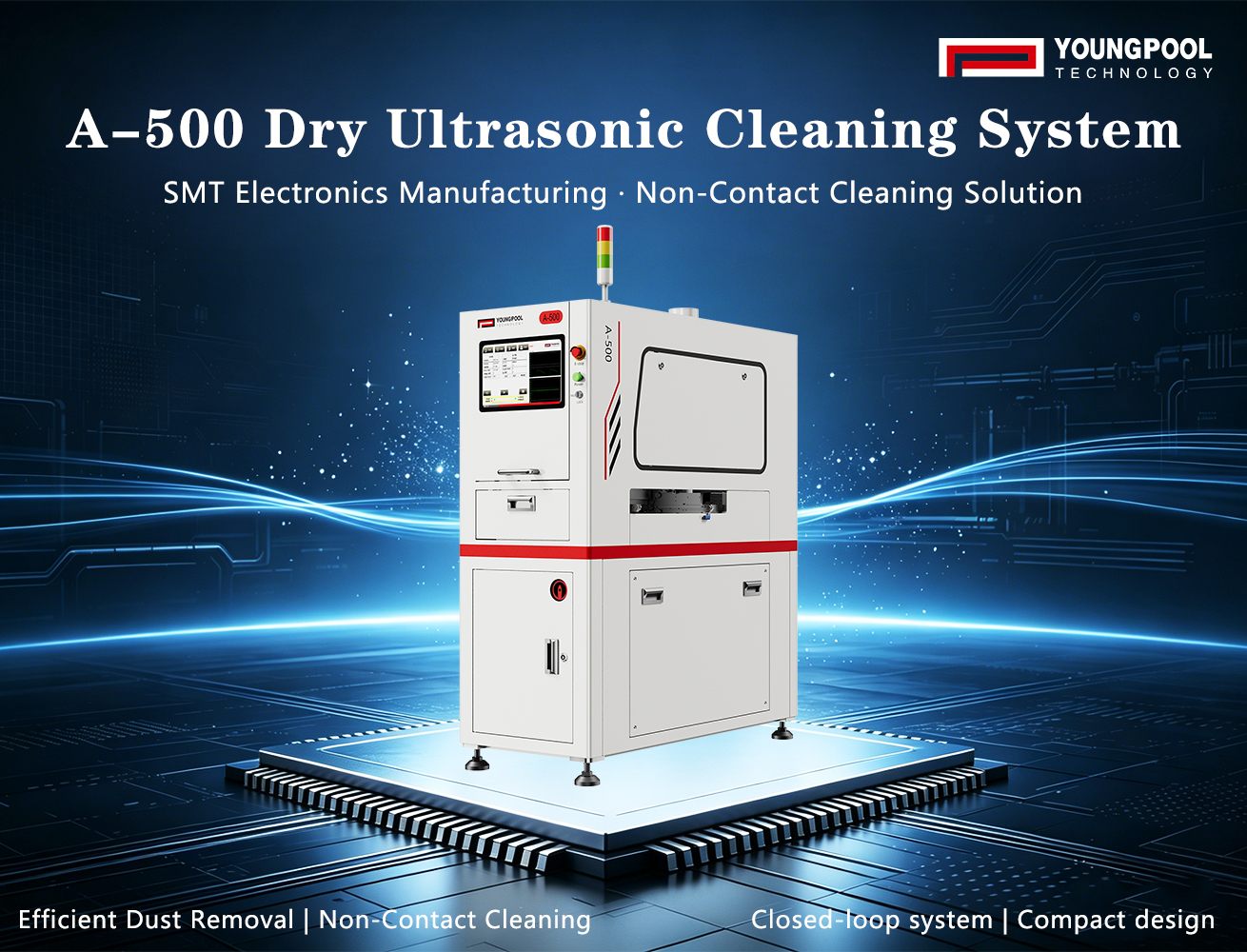
This cleaning method uses clean air as the medium to effectively remove non-adhesive dust through a non-contact approach. According to equipment data, the removal efficiency can exceed 97%. In practical applications, this method avoids mechanical interference with components and structures, while demonstrating strong adaptability to three-dimensional surfaces such as through-holes and stepped geometries. Additionally, it does not rely on consumables such as cleaning fluids, helping to reduce operational complexity. The coordinated action of cleaning and negative pressure extraction further minimizes the risk of dust residue and reattachment.
Moreover, the equipment adopts a closed-loop system design, ensuring that it does not disturb the airflow organization or pressure balance within the workshop, making it particularly suitable for stable operation in environments with stringent cleanliness requirements.
Application Extension: Broken Probe Cleaning
In actual SMT production, the issue of “broken probes” (e.g., residues from fractured test probes, fixture pins, or related microstructures) is a typical source of fine particle contamination. These foreign particles are often localized and irregularly distributed, making them difficult to handle precisely with traditional contact cleaning methods, while wet cleaning introduces redundant process steps.
In such scenarios, the dry ultrasonic cleaning machine applies non-contact airflow to localized areas, effectively dislodging broken probe residues or debris without disturbing surrounding structures. The integrated negative pressure extraction ensures timely removal of particles after detachment, thereby reducing the risk of secondary contamination.
Application Value of Dry Ultrasonic Cleaning Machines
From a production line perspective, the value of dry ultrasonic cleaning machines lies not only in the removal of dust and broken probes, but also in enhancing process stability. During placement and soldering processes, surface particle contamination can lead to solder joint defects or insufficient soldering. By introducing a stable cleaning step at critical points, process variations caused by contamination can be reduced, thereby improving process consistency.
Compared to wet cleaning processes that involve multiple steps such as washing, rinsing, and drying, dry cleaning completes the process in a single step. This helps shorten the process flow, reduce equipment configuration complexity, and lower daily management costs. Additionally, the absence of cleaning fluids reduces long-term material consumption and associated environmental treatment burdens.
In terms of automation integration, the equipment supports both single-lane and dual-lane configurations and can be integrated with MES systems, enabling inline deployment and data-driven management without affecting line takt time. Its closed-loop structural design also helps maintain cleanroom airflow and pressure stability, ensuring consistency across the production environment.
Within the SMT manufacturing system, the role of cleaning is gradually shifting from “problem correction” to “process prevention.” The Youngpool Technology A-500 Dry Ultrasonic Cleaning Machine, centered on non-contact airflow cleaning, provides a simplified and controllable solution for typical scenarios such as non-adhesive particle removal and broken probe cleaning.
By improving cleanliness levels without adding process burden, this stability-oriented optimization approach is becoming an increasingly important component of lean manufacturing.


 IPv6 network supported