Categories
New Blog
SMT warehouse reels: used halfway, then returned — what splitting saves is the books, not just the material.
Nov 05, 2026A line needs 2,000 components, so the warehouse issues a full reel of 5,000. The line uses 2,000 and returns the remaining 3,000. The return is booked, the reel goes back on the shelf. It sounds clean — except that the odd 3,000 on that reel may not be 3,000 at all.
In practice it usually isn't. The remainder gets established three different ways — by counting, by weighing, or by trusting the original label — and when the three disagree, a “close enough” figure goes into the system. The difference accumulates, one reel at a time.
1. The root cause: the issue unit is too large
If the smallest unit you can issue is a full reel, every issue produces a remainder, and every remainder needs a manual check. The more often you check, the more often you get it wrong.
A reel splitter attacks that structural problem directly: it breaks a large reel into small ones sized to demand, so the issue unit matches actual consumption and the remainder never exists in the first place.
2. How the D-1 works
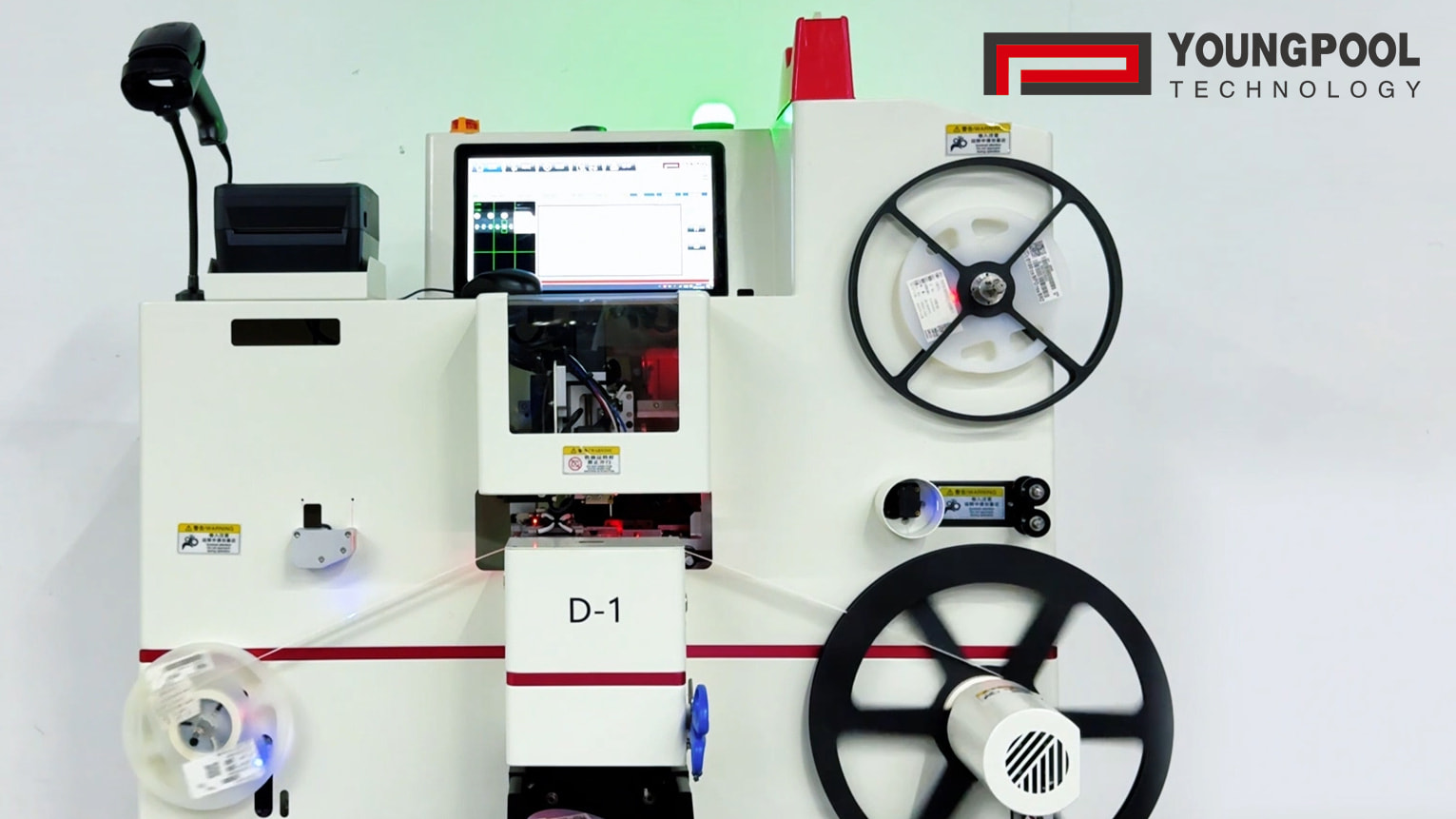
The Youngpool D-1 splitting machine can take splitting instructions automatically from an MES system, or accept a quantity entered by hand. It covers 8/12/16/24 mm tape, handles both paper and plastic carrier tape, and takes pockets up to 15 mm deep.
Against manual work, splitting and counting efficiency more than 30% higher, counting accuracy above 99%, and operator workload down by over 50%. What those numbers mean in practice is simple: splitting no longer depends on someone counting by hand. A machine does it — and does it the same way every time.
3. It is not only the counts that come right
Once splitting is in place, what moves through the warehouse is small reels sized to need, and what sits at the line side is the same. Half-used reels stop occupying shelf space, and finding, counting and returning material all get simpler.
Most plants buy a splitter to save money. What improves first is the state of the shop floor.
4. Setting the splitting rule
There are three common rules: by day — split according to the day's plan; by work order — split to the quantity the order actually needs; by batch — split a whole batch at once.
Splitting by day is flexible and suits high-mix, low-volume work. Splitting by work order is the most accurate, and suits stable orders with larger volumes. Splitting by batch is the least work, but carries the highest remainder risk.
Most plants end up with a hybrid: work order first, day as the top-up. Write the rule into the work instruction and let the machine follow it, and you stop getting one rule today and another tomorrow.
A remainder is not a stocktake problem. It is created the first time a whole reel is issued.
About Youngpool Technology
Shenzhen Youngpool Technology Co., Ltd. (YOUNGPOOL Technology) has spent 20 years in electronics manufacturing equipment. Its products span three lines: tape handling — the L-900 Intelligent Splicing Machine, D-1 Intelligent Reel Splitter and L-930 Automatic Merging Machine; laser processing — the M2-900L Laser Marking System and LD-4 Laser Depaneling Machine; and cleaning and process assurance — the A-500 Dry Ultrasonic Cleaner and N-800A Vacuum Degassing Machine. Guided by the principles of “easy to use, reliable, intelligent”, the company supplies equipment and process solutions to electronics manufacturers.


 IPv6 network supported