
Categories
New Blog
Splicing on an SMT Line: Should It Still Be Done by Hand?
Nov 03, 2026Most plants work out the cost of splicing by counting what one operator costs per month. The arithmetic is right, but it only covers half the cost — the other half hides in line stoppages. Tape gets spliced slowly, or crookedly, and the mounter has to wait; worse, the tape jams or throws parts once it goes on, and the whole line stops.
Stoppages have one particular feature: they never show up on the payroll, they never land in a report, and they are quickly written off as “normal loss”. Dig into it and most shops keep no record at all.
1. What one stoppage actually costs
A rough but workable estimate: minutes of downtime × boards per minute × value per board.
Take a line that produces 100 boards an hour, with board value counted at 20 yuan. Ten minutes of downtime is about 330 yuan; two splicing-related stops a day, across 26 days, comes to over 17,000 yuan a month. That is before rework, scrap and late delivery.
And it is a conservative estimate. Many plants stop more often than twice a day — they have simply never given it a column of its own.
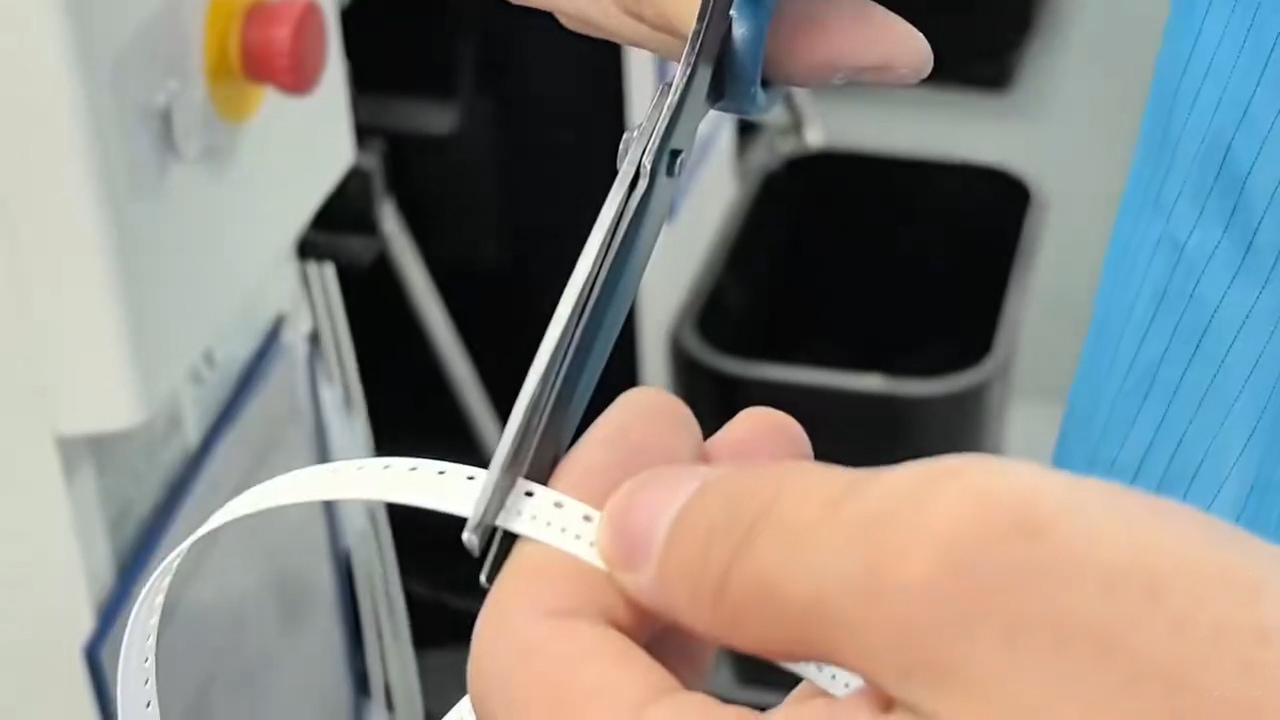
2. What a splicer removes is the uncertainty
The Youngpool L-900 Splicing Machine is not a complicated machine. Its vision system locates the sprocket holes and pocket positions, compensates for any offset in real time, and then cuts and applies the tape in a single pass. One splice takes 16 seconds or less, and that figure covers the full cycle including LCR measurement — not just the mechanical movement. The tape goes straight onto the mounter, with first-pass yield above 98%.
Speed matters less than predictability: how long a splice takes, and whether the result can be used, no longer depend on who is on shift today.
3. When the numbers start to work
The test is simple. If splicing causes two or three stoppages or re-checks a day, or the line changes reels more than ten times a day, manual labour has already passed the point where the equipment pays for itself.
Conversely, a line that changes reels two or three times a day is genuinely cheaper run by hand. The machine is not a necessity — it only makes sense once the cost of downtime passes a certain point.
4. Start with something that costs nothing
If you run production or equipment at an SMT plant, log the downtime before deciding whether to buy anything. It takes one sheet of paper at the splicing station: every stop or re-check caused by splicing, with the time, the part number and the reason. Two weeks of that gives you both the frequency and the average duration.
With those two numbers the multiplication above starts to mean something — you are using your own figures rather than someone else's estimate. Many projects stall on “we can't say what it really costs us”; it takes two or three weeks to answer.
Splicing looks like a small job; downtime is big money. The two simply never appear on the same page of a report.
About Youngpool Technology
Shenzhen Youngpool Technology Co., Ltd. (YOUNGPOOL Technology) has spent 20 years in electronics manufacturing equipment. Its products span three lines: tape handling — the L-900 Intelligent Splicing Machine, D-1 Intelligent Reel Splitter and L-930 Automatic Merging Machine; laser processing — the M2-900L Laser Marking System and LD-4 Laser Depaneling Machine; and cleaning and process assurance — the A-500 Dry Ultrasonic Cleaner and N-800A Vacuum Degassing Machine. Guided by the principles of “easy to use, reliable, intelligent”, the company supplies equipment and process solutions to electronics manufacturers.
Hotline: +86 136 4095 0259 (WeChat) | www.youngpool.com


 IPv6 network supported