Categories
New Blog
Is an SMT Automatic Splicing Machine Really Worth the Investment? Which Manufacturers Benefit the Most?
Jun 30, 2026
As SMT automation continues to advance, more and more electronics manufacturers are considering investing in **SMT Automatic Splicing Machines**. However, before making a purchasing decision, many manufacturers ask the same question:
Is an Automatic Splicing Machine really necessary?
The answer depends on your production environment rather than the equipment itself. Whether an Automatic Tape Splicing Machine is the right investment largely depends on your production model, reel change frequency, and operational management requirements.
If Your SMT Line Requires Frequent Reel Changes, the Benefits Become More Obvious
For manufacturers operating high-mix, low-volume (HMLV) production, reel changes may occur dozens or even hundreds of times per day. Although each reel change takes only a short time, repetitive tasks such as tape splicing, tape trimming, and splice verification consume valuable operator time. At the same time, manual variations can affect splicing quality, leading to inconsistent production performance.
When reel changes become a routine part of daily operations, manufacturers naturally begin looking for ways to improve **reel change efficiency**, reduce repetitive manual work, and achieve more consistent tape splicing.
If Production Stability Is Your Priority
Beyond production efficiency, maintaining stable production is another important reason why many manufacturers invest in automatic tape splicing equipment. Traditional manual tape splicing relies heavily on operator experience. Differences in alignment accuracy, operating techniques, and workmanship can result in inconsistent splicing quality. If splice alignment varies or the splice joint is uneven, the carrier tape may not feed smoothly through the feeder, potentially affecting downstream production.
For SMT production lines running continuous shifts, implementing a standardized tape splicing process helps minimize human variation and supports more stable manufacturing operations.
If Your Factory Is Moving Toward Digital Manufacturing
As more electronics manufacturers embrace smart factory initiatives, production data management has become increasingly important. For tape splicing operations, manufacturers are no longer concerned only with completing the splice itself. They also want splicing data to be automatically recorded, tracked, and integrated into their production management system for better traceability and process analysis.
As a result, SMT Automatic Splicing Machines that support **MES integration** are becoming an increasingly important part of factory automation and digital transformation strategies.
Where Does the YOUNGPOOL L-900 Fit?
Designed for the evolving needs of modern SMT manufacturing, the YOUNGPOOL L-900 Intelligent Automatic Splicing Machine helps manufacturers standardize tape splicing while improving operational efficiency.
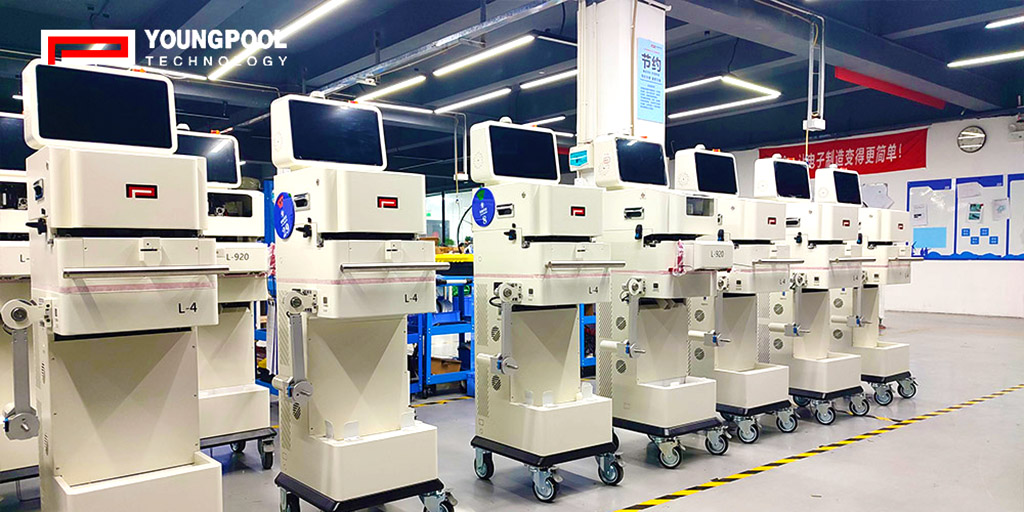
The L-900 supports 8 mm, 12 mm, 16 mm, and 24 mm carrier tapes and is compatible with both paper and embossed plastic tapes, making it suitable for most common SMT component packaging formats. The machine is equipped with an intelligent vision system to assist with carrier tape recognition and positioning, helping improve splicing consistency by reducing variations caused by manual alignment.
In addition, the L-900 features automatic empty tape detection, automatic tape cutting, and MES integration, helping manufacturers simplify reel change procedures while supporting standardized production management.
For factories with frequent reel changes, high-mix production, or ongoing digital transformation projects, these capabilities make the L-900 a practical solution for modern SMT manufacturing.
Not Every SMT Factory Needs an Automatic Splicing Machine
It is important to note that an SMT Automatic Splicing Machine is not essential for every manufacturer. If your production consists of a limited number of products with relatively few reel changes, manual tape splicing may still be sufficient.
However, for manufacturers producing multiple product variants, operating high-speed production lines, performing frequent reel changes, or investing in factory automation and digitalization, adopting an SMT Automatic Splicing Machine can help establish a more standardized reel change process while improving overall production management.
Whether an Automatic Tape Splicing Machine is worth the investment depends on the challenges your factory is trying to solve.
If frequent reel changes, inconsistent splicing quality, increasing labor demands, or digital production management have become obstacles to improving SMT production efficiency, investing in the right SMT Automatic Splicing Solution can provide greater long-term value than simply adding more operators.
Rather than viewing an automatic splicing machine as just another piece of equipment, manufacturers should consider it an important step toward more standardized, efficient, and intelligent SMT production.
Email: shicx@youngpool.com
Tel: +86 181 2417 2940


 IPv6 network supported